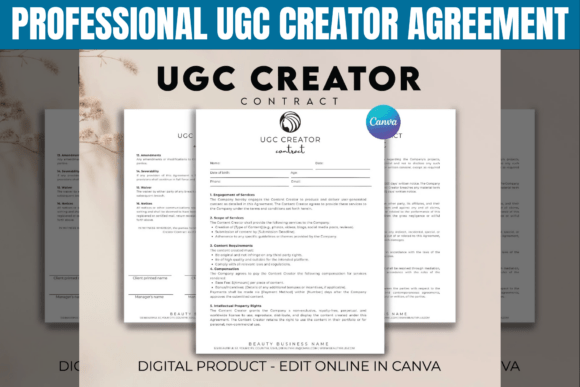
Professional UGC Creator Agreement: Your Business Foundation
As a UGC creator, your work is creative, but your business is built on clear agreements. A Professional UGC Creator Agreement isn't just a formality; it's the essential framework that protects your work, defines expectations, and ensures you get paid. Think of it as the brand identity for your business operations—consistent, professional, and instantly recognizable. Just as a premium font establishes visual tone, a solid contract establishes the tone of your client relationships, preventing misunderstandings before they start.
Why a Standard Contract Template is a Game-Changer
Relying on email chains or verbal agreements is like designing a logo without a grid system. It might work once, but it's not scalable or sustainable. A Professional UGC Creator Agreement template provides that critical structure. It’s a comprehensive design asset for your business, covering key areas like content usage rights, revision limits, payment terms, and ownership. This isn't about being rigid; it's about creating a reliable, repeatable process. When you use a well-drafted template, you streamline client onboarding, project management, and invoicing. You move from ad-hoc negotiations to a standardized, professional workflow, which enhances your credibility and lets you focus on the creative work.
Key Components You'll Customize
The real power of a template lies in its adaptability. A quality Professional UGC Creator Agreement will include clear sections you can tailor to each project:
- Scope of Work: Define exactly what content you'll deliver—number of posts, video lengths, platforms, and deliverables.
- Usage Rights & Licensing: This is crucial. Specify where and for how long the brand can use your content (e.g., organic social only, paid ads, website). This directly impacts your pricing.
- Compensation & Payment Schedule: Outline your fee, deposit requirements, and invoicing terms. Pairing this with a professional Invoice Template creates a seamless financial process.
- Revisions & Feedback: Set a clear limit on revision rounds to avoid endless feedback loops, protecting your time and creative energy.
- Ownership & Copyright: Clarify who retains the original creative work. Often, the creator retains copyright while granting a license for use.
Integrating with Your Creative Toolkit
Your contract shouldn't feel like a disconnected legal document. It should integrate smoothly into your existing creative and business tools. This is where editable templates shine. A Professional UGC Creator Agreement designed in a platform like Canva allows you to maintain visual consistency with your brand. You can adjust colors, fonts, and layout to match your personal brand identity, making every client touchpoint feel cohesive. Furthermore, bundling your agreement with complementary templates—like a Client Intake Form to gather project details, a Content Calendar for planning, and a Performance Report to showcase results—creates a full suite of professional design assets. This holistic approach signals to clients that you're organized, thorough, and serious about your craft.
Practical Application: From Agreement to Invoice
Here’s how it works in practice. You secure a new client. Instead of drafting a contract from scratch, you open your Professional UGC Creator Agreement template. You customize the Client Intake Form with their project specifics, then plug those details into the main agreement. Once signed, you use the Content Calendar template to plan deliverables and the Performance Report to track engagement. Finally, you generate an invoice using a matching template. This integrated system does more than save time; it builds a professional perception of your business. The visual consistency across all documents—from contract to invoice—reinforces your brand and makes the entire collaboration feel more established and trustworthy.
Making the Template Work for You
Choosing and using a contract template is a strategic decision. Look for a Professional UGC Creator Agreement that is:
- Comprehensive but Clear: It should cover all essential legal and practical points without being filled with impenetrable jargon. You need to understand it to explain it to clients.
- Fully Editable: The ability to modify every section is non-negotiable. Your services, pricing, and terms are unique. The template must bend to fit your business, not the other way around.
- Professionally Designed: A clean, well-organized layout isn't just about looks. It improves readability and helps clients quickly find key information, which speeds up the review and signing process.
Remember, the goal isn't to replace legal advice for complex situations. For significant partnerships, consulting a lawyer is wise. However, for the majority of your standard projects, a robust, customizable template provides the professional foundation you need. It minimizes risk, clarifies expectations, and ultimately protects the value of your creative work, allowing you to build sustainable, long-term client relationships. Think of it as the essential typeface for your business communications—clear, reliable, and perfectly suited to your professional voice.